The Greatest Giants of Sherwood |
by Roger A.Redfern |
Country Life Jan 17, 1974 |
Old Sherwood extended from Nottingham
in the South to within a couple of
miles of Worksop in the North, to the
outskirts of Chesterfield in the West and to
Southwell and Laxton in the East. It was
always a scattered forest punctuated by broad
tracts of heath. The infertile Bunter sandstone
underlying the area has been largely responsible
for the salvation of the woodlands, for it
prevented it being cleared for agricultural use.
If Sherwood was spared by the farmer it
became an attractive prize for the carpenter.
In 1337 Edward III ordered the Prior of Blyth
to deliver 40 oaks to the King's carpenter for
the construction of a galley at Kingston-upon-Hull.
Major Hayman Rooke (who catalogued
the Sherwood oaks in the 18th century) records
that in 1609 a survey of the trees remaining
showed there were 49,909 in the portions called
Bilaugh and Birklands. There were 2,593 fewer
in 1689, a reduction that includes loss by
natural decay. But there was little thought of
replacement. Kilton Plantation, near Worksop,
was sown with acorns in 1763, but the ancient
heart of the Forest was not conserved in this
way.
By 1790 a survey showed that there were
only 10,117 trees remaining in Bilaugh and
Birklands, valued at £17,147 15s 4d. Two-thirds
of the trees had gone in a century,
many for timber and many cleared for convenience
when the great estates were being
enclosed from the Forest. In 1707, for instance,
the Duke of Newcastle obtained permission to
make a 3,000-acre park at Clumber, and in
1709 he was allowed to make "a broad riding-way
through Birklands Wood, of a width of
80 yards". The value of the timber cleared to
make this ride was £1,500.
Though the formation of the great estates
resulted in the natural Forest area being
reduced, what was left within their boundaries
was to some extent safeguarded from later
depredations. Most of the greatest trees
remaining today are found within these estates.
One exception is the best known of all-
probably the best-known tree in Britain-
which stands in the Birklands area of
Sherwood, a mile North of Edwinstowe. It was
formerly called the Queen Oak, but more
recently has come to be known as the Major
Oak, whether due to its great size or to
the memory of Major Hayman Rooke is a
matter for conjecture. It stands at the northern
extremity of the newly established Sherwood
Country Park, in the care of Nottinghamshire
County Council. This great tree has a girth
of 64 feet, and it is claimed that 34 children
can get inside its hollow trunk.
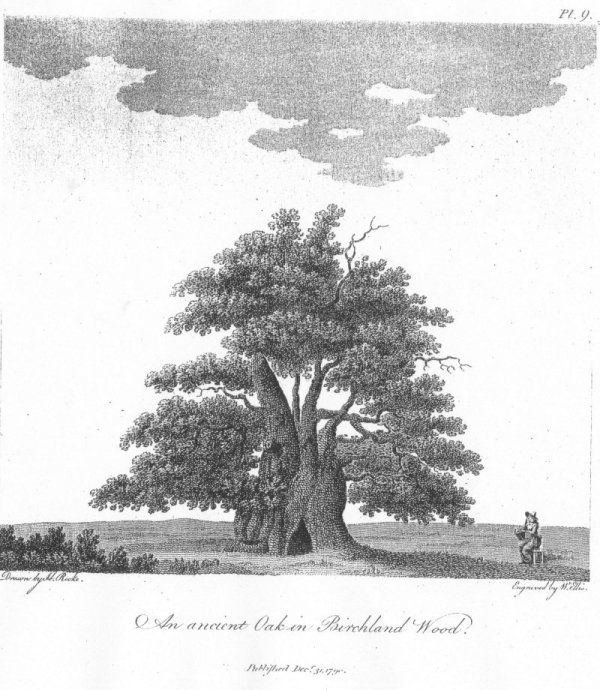
The Major Oak is undoubtedly the most
popular spot in the Forest area, and the path
to it and ground around it are now devoid of all
vegetation because of the number of people
that have stood upon the infertile sandy soil.
What a contrast with pictures of the tree two
centuries ago when an old man kept fowls
under the venerable giant. It was known at
that time as the Cockpen-tree. On August
Bank Holiday Monday, 1957, no fewer than
15,000 people came to look at the Major Oak.
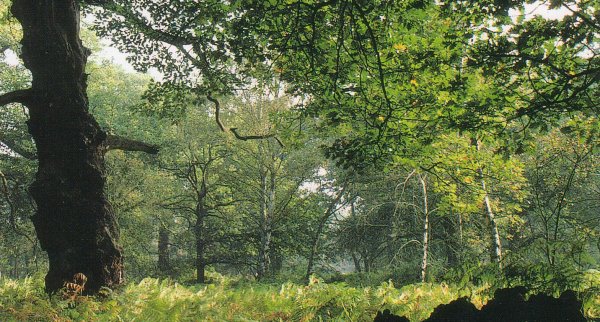
In that part of Birklands to the West of
the Major Oak is an area dominated by the
remains of decaying oaks - "stag-headed oaks".
Most of the trees of Sherwood are either sessile
or pedunculate oaks, both deep-rooting
species. During this century local water
undertakings have extracted vast quantities
of water from the Bunter sandstone layers
under the Forest. The water table has been
lowered (aided by new coal-mining developments),
resulting in the slow death of many of
the great oaks, hence the "stag-headed" form
because the trees tend to die down from
their outermost branches. It is amazing to find
so many huge oaks so near death and yet still
managing each spring to send out new foliage.
At the heart of Birklands stood the most
famous blighted oak, called the Shambles Oak
or Robin Hood's Larder. Inside its hollow
trunk were iron hooks upon which was hung
stolen venison. Writing in 1913, Robert
Murray Gilchrist reported that the tree had
been set on fire by a picnic party some years
before and that there is "something pathetic
in the valiant greenness of its scanty leaves.
It is like an old, old man who will be brave to
the end." That end came about
eight years ago when the ancient
shell was finally blown down by
the wind. Between the Major
Oak and the site of Robin Hood's
Larder and extending from North
to South is the 80-yard wide
"Duke's Ride" already mentioned.
Halfway along this
straight ride is the fine Centre
Tree. Unlike so many of
the notable oaks of the district
this specimen, probably planted
soon after the ride was formed in
1709, is in its prime.
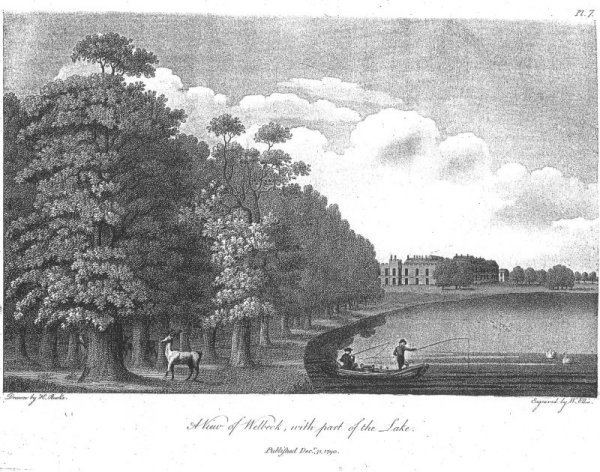
Of the great estates enclosed
from the Forest undoubtedly the
richest in old oaks was Welbeck
Park. Some of the giants have
now decayed and gone for ever,
others still adorn this, the seat of
the Duke of Portland. It was
recorded in 1875 that "Welbeck
contains 2,283 acres, 3 roods,
3 perches of land and anciently
formed part of the Manor of
Cuckney, which was held by
Sweyn, a Saxon". Major Hayman
Rooke described the finest trees in
his Descriptions and Sketches of
Remarkable Oaks in Welbeck Park,
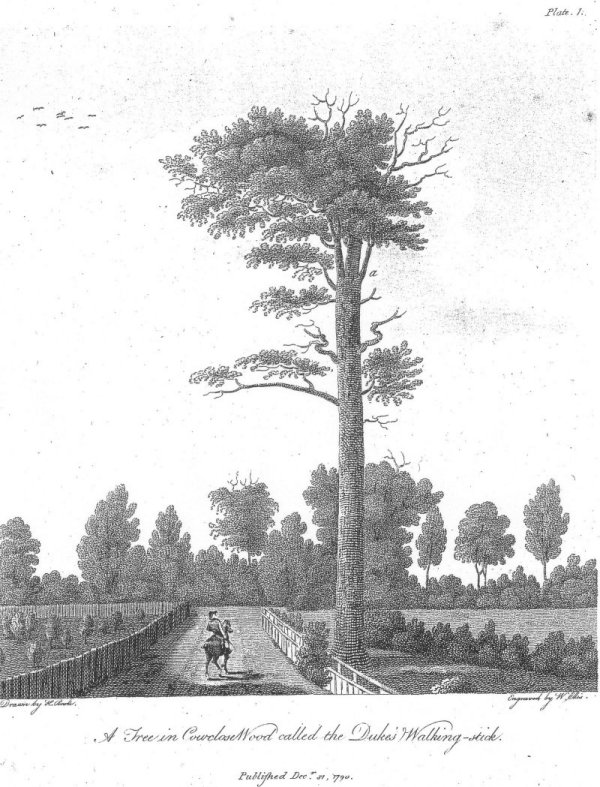
published in 1790. The Duke's
Walking Stick was an oak
"perhaps unmatched by any
other in the Kingdom for height
and straightness". It has long
since disappeared but in its prime measured
111 feet 6 inches in height, contained 440cubic
feet of solid timber and weighted 11 tons.
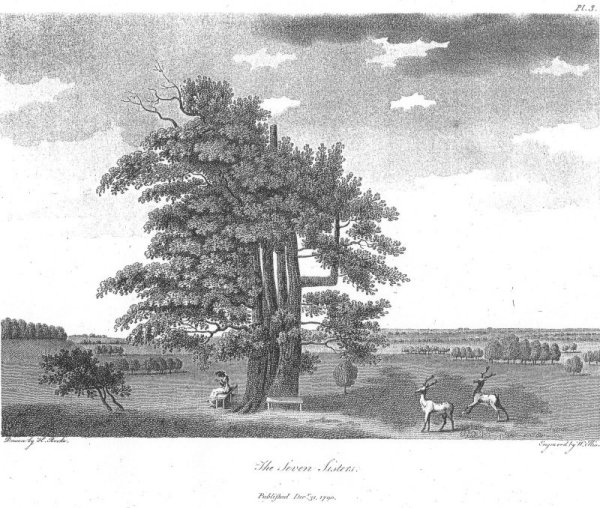
Upon the gentle slope of Hagg Hill, to the
East of Repton's Great Lake, grew the Seven
Sisters Oak. This had seven trunks growing
from one root to a height of 90 feet. In 1873
it was reported that "the circumference at the
bottom is about 30 feet. Several of these stems
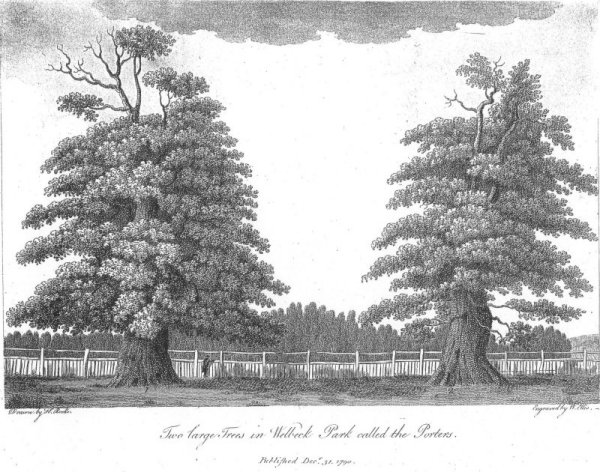
were long since blown down". A pair of
ancient oaks still stand on either side of the
main drive from the Lion Gate to Welbeck
Abbey. At one time a huge gate was hung
across the drive between them, and for this
reason they are known as the Porter Oaks. In
1875 Robert White recorded that "the height
of one is about 100 feet, and its circumference
about 38 feet; the other is about 90 feet high,
and about 34 feet in circumference". The trees
are now much reduced in size, having been
capped with lead to protect them from the
elements. But they are still impressive, backed
by younger conifers and the sweep of the park.
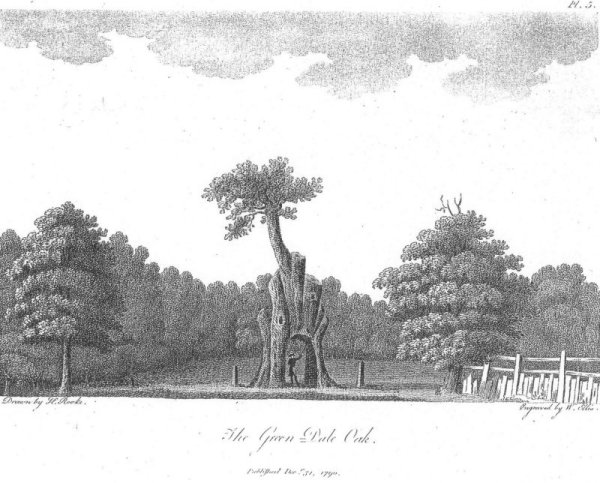
Of all the trees of Sherwood the most
remarkable is the Greendale Oak. It
stands almost unnoticed at the centre of
Welbeck Park, half a mile to the South of
Welbeck Abbey. Once probably the greatest
tree of the Forest, the first Duke of Portland
said that he could drive a carriage through it
and in 1724 had an arch cut out of the trunk
to prove his claim. The timber removed was made into
a cabinet for the countess of
Oxford three years later. It contains
inlaid pictures of the tree
and the Duke of Portland driving
a carriage and six horses through
the arch. The cabinet is still at
Welbeck.
Major Hayman Rooke considered
the Greendale Oak "to be
above seven hundred years old"
in 1790, while in 1797 Throsby
said "it is supposed to be upwards
of 1,500 years old". In any event
the tree never fully recovered
from the removal of the archway
and during the last century it was
"planked diagonally and otherwise
supported". Chains were
later fitted to hold up its spreading
branches, at that time still extending
over a diameter of 45 feet
Today this former glorious
giant is but a tumbled heap of seasoned
timber, festooned still with
old chains and wooden supports.
Standing beside it, though, one
can appreciate its monstrous
proportions at its prime:
Whose head above his fellow of the grove
Doth tower, as these above the sward beneath.
|
 All Rights Reserved.